Born Again Christian Are Protestant Chrisitans
Christians remain by far the largest religious group in the United States, simply the Christian share of the population has declined markedly. In the past seven years, the pct of adults who describe themselves every bit Christians has dropped from 78.4% to lxx.6%.
Once an overwhelmingly Protestant nation, the U.S. no longer has a Protestant majority. In 2007, when the Pew Inquiry Center conducted its kickoff Religious Landscape Report, more than half of adults (51.3%) identified equally Protestants. Today, by comparison, 46.5% of adults describe themselves equally Protestants.
While there have been declines across a variety of Protestant denominations, the most pronounced changes accept occurred in churches in the mainline Protestant tradition, such every bit the United Methodist Church building and the Evangelical Lutheran Church in America. The share of adults belonging to mainline churches dropped from eighteen.1% in 2007 to fourteen.7% in 2014. This is similar to the drop seen amidst U.Southward. Catholics, whose share of the population declined from 23.ix% to xx.8% during the same seven-yr period.
In dissimilarity with mainline Protestantism, at that place has been less modify in recent years in the proportion of the population that belongs to churches in the evangelical or historically black Protestant traditions. Evangelicals now brand upwards a clear majority (55%) of all U.S. Protestants. In 2007, 51% of U.S. Protestants identified with evangelical churches.
While the overall Christian share of the population has dropped in recent years, the number of Americans who do not identify with whatsoever religion has soared. Nearly 23% of all U.S. adults at present say they are religiously unaffiliated, up from near 16% in 2007. While most of the unaffiliated describe themselves as having "no particular religion," a growing share say they are atheists or agnostics.
This chapter takes a close look at the current religious composition of the United States and how information technology has changed since 2007. A full-page table (PDF) summarizes the religious affiliation of U.South. adults in a manner that captures pocket-size groups that make up less than ane% of the population.
The chapter also explains how Protestant respondents were sorted into the three distinct Protestant traditions – the evangelical Protestant tradition, the mainline Protestant tradition and the historically black Protestant tradition – and it documents which Protestant denominations are shrinking, and which are growing.
Finally, the chapter examines the growth of non-Christian religions in the U.S. and takes a closer look at the limerick of the religiously unaffiliated population.
Measuring and Categorizing Protestantism
American Protestantism is various, encompassing more than than a dozen major denominational families – such as Baptists, Methodists, Lutherans and Pentecostals – all with unique beliefs, practices and histories. These denominational families, in plough, are made up of a host of different denominations, such as the Southern Baptist Convention, the American Baptist Churches U.s.a. and the National Baptist Convention.
Denominations: The term "denomination" refers to a set up of congregations that belong to a unmarried authoritative construction characterized by particular doctrines and practices. Examples of denominations include the Southern Baptist Convention, the American Baptist Churches USA and the National Baptist Convention.
Families: A denominational family unit is a ready of religious denominations and related congregations with a mutual historical origin. Examples of families include Baptists, Methodists and Lutherans. Most denominational families consist of denominations that are associated with more one of the three Protestant traditions. The Baptist family, for instance, consists of some denominations that fall into the evangelical tradition, others that belong to the mainline tradition and however others that are role of the historically black Protestant tradition.
Traditions: A religious tradition is a set up of denominations and congregations with like behavior, practices and origins. In this report, Protestant denominations are grouped into three traditions: the evangelical tradition, the mainline tradition and the historically black Protestant tradition.
Because of this great diverseness, American Protestantism is best understood non as a single religious tradition but rather every bit three singled-out traditions – the evangelical Protestant tradition, the mainline Protestant tradition and the historically black Protestant tradition. Each of these traditions is made up of numerous denominations and congregations that share like beliefs, practices and histories.
For instance, churches inside the evangelical tradition tend to share religious beliefs (including the confidence that personal acceptance of Jesus Christ is the only mode to conservancy), practices (similar an emphasis on bringing other people to the religion) and origins (including separatist movements against established religious institutions). Churches in the mainline tradition, by dissimilarity, share other doctrines (such every bit a less exclusionary view of conservancy), practices (such equally a potent emphasis on social reform) and origins. Churches in the historically black Protestant tradition take been shaped uniquely by the experiences of slavery and segregation, which put their religious behavior and practices in a special context.
 As much as possible, Protestant respondents were categorized into i of the 3 Protestant traditions based not on their denominational family, but rather on the specific denomination with which they identify. Most Protestant denominational families include denominations that are associated with dissimilar Protestant traditions. For instance, some Baptist denominations (like the Southern Baptist Convention) are part of the evangelical tradition; others (such as the American Baptist Churches U.s.) are part of the mainline tradition; and even so others (such as the National Baptist Convention) are function of the historically blackness Protestant tradition.
Overall, 60% of Baptists in the survey place with denominations in the evangelical tradition; 14% associate with denominations in the mainline Protestant tradition, and 26% identify with denominations that are part of the historically black Protestant tradition. (While the Baptist family unit of denominations includes churches in all three Protestant traditions, this is non the case for all denominational families, some of which have members in just 1 or two of the Protestant traditions.)
Despite the detailed denominational measures used in the Religious Mural Study, many respondents (more than a quarter of all Protestants) were either unable or unwilling to draw their specific denominational affiliation. For instance, some respondents describe themselves as "just a Baptist" or "but a Methodist." Respondents with this type of vague denominational amalgamation were sorted into one of the 3 Protestant traditions in 2 ways.13
Start, blacks who gave vague denominational affiliations (e.one thousand., "simply a Methodist") merely who said they vest to a Protestant family with a sizable number of historically black churches (including the Baptist, Methodist, nondenominational, Pentecostal and Holiness families) were coded as members of the historically black Protestant tradition. Blackness respondents in denominational families without a sizable number of churches in the historically black Protestant tradition were coded every bit members of the evangelical or mainline Protestant traditions depending on their response to a separate question asking whether they would identify as a born-again or evangelical Christian.
2nd, non-black respondents who gave vague denominational identities and who described themselves as built-in-again or evangelical Christians were coded as members of the evangelical tradition; otherwise, they were coded every bit members of the mainline tradition.fourteen
Overall, 38% of Protestants offered a vague denominational identity and thus were classified on the basis of their race and/or their answer to the question about whether they identify every bit a born-again or evangelical Christian. This includes 36% of those in the evangelical tradition, 35% of those in the mainline tradition and 53% of those in the historically black Protestant tradition.
The Shifting Limerick of American Protestantism
Recent years have brought a dramatic decline in the share of Americans who identify with mainline Protestant denominations. Today, just 15% of all U.S. adults place with mainline Protestant churches, downward from xviii% in 2007. Past comparison, evangelical Protestantism and the historically blackness Protestant tradition have been more than stable. Today, 25% of U.S. adults place with evangelical denominations, downwardly less than 1 percentage bespeak since 2007. And roughly vii% of American adults identify with the historically black Protestant tradition, little inverse since 2007.
The mainline tradition's share of the Protestant population has declined along with its share of the overall population. Today, 32% of Protestants identify with denominations in the mainline tradition, down from 35% in 2007. Evangelicals at present establish a articulate majority of all Protestants in the U.Southward., with their share of the Protestant population having risen from 51% in 2007 to 55% in 2014.

Many Protestant denominational families have seen their share of the U.S. population autumn since 2007. Baptists now business relationship for approximately 15% of the adult population, downwards from 17% in 2007. Methodists and Lutherans also take declined by more than than a full percentage point in recent years. The family that shows the nigh significant growth is the nondenominational family; today, 6.2% of all adults (and thirteen% of Protestants) identify with nondenominational churches, up from four.5% of all adults (and 9% of all Protestants) in 2007.

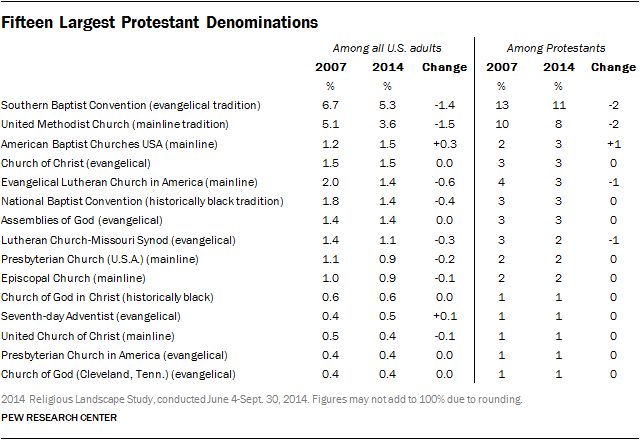
The Southern Baptist Convention (an evangelical denomination) and the United Methodist Church building (a mainline denomination) proceed to be the two largest Protestant denominations in the U.South.; eleven% of Protestants identify with the Southern Baptist Convention and 8% identify with the United Methodist Church. Both denominations, however, have experienced declines in their relative share of the population. In the 2014 Religious Mural Study, 5.3% of all U.S. adults place with the Southern Baptist Convention (downward from 6.seven% in 2007) and 3.6% identify with the United Methodist Church building (down from 5.1% in 2007).
Growth of Non-Christian Faiths
 The 2014 Religious Landscape Written report finds that 5.ix% of U.Southward. adults identify with faiths other than Christianity, upwardly slightly, but significantly, from 4.7% in 2007. The largest of these faiths is Judaism, with 1.nine% of respondents identifying themselves as Jewish when asked about their religion. Amidst Jews surveyed, 44% place with Reform Judaism, 22% with Bourgeois Judaism, 14% with Orthodox Judaism, 5% with other Jewish movements and xvi% with no detail Jewish denomination. These findings are broadly similar to results from the Pew Research Centre's 2013 survey of Jewish Americans.xv
Muslims (0.nine%), Buddhists (0.7%) and Hindus (0.7%) each make up slightly less than 1% of respondents in the 2014 Religious Mural Study. The Muslim and Hindu shares of the population accept risen significantly since 2007. And information technology is possible, even despite this growth, that the Religious Landscape Study may underestimate the size of these groups. The written report was conducted in English language and Castilian, which ways that groups with in a higher place-average numbers of people who do not speak English or Spanish (such as immigrants from Asia, Africa and other parts of the world) may exist underrepresented. For case, an analysis of the Pew Enquiry Center's 2012 survey of Asian Americans (conducted in English language, Cantonese, Hindi, Japanese, Korean, Standard mandarin, Tagalog and Vietnamese) estimated that Buddhists business relationship for between 1.0% and 1.3% of the U.S. adult population, and that Hindus account for betwixt 0.5% and 0.eight% of the population. The Pew Research Heart's 2007 and 2011 surveys of Muslim Americans (conducted in English, Arabic, Farsi and Urdu) estimated that Muslims accounted for 0.half dozen% of the developed population in 2007 and 0.8% in 2011.
The 2014 Religious Mural Study finds that 0.3% of American adults identify with a wide variety of other world religions, including Sikhs, Baha'is, Taoists, Jains, Rastafarians, Zoroastrians, Confucians and Druze. An additional 1.5% identify with other faiths, including Unitarians, those who identify with Native American religions, Pagans, Wiccans, New Agers, deists, Scientologists, pantheists, polytheists, Satanists and Druids, to proper noun simply a few.
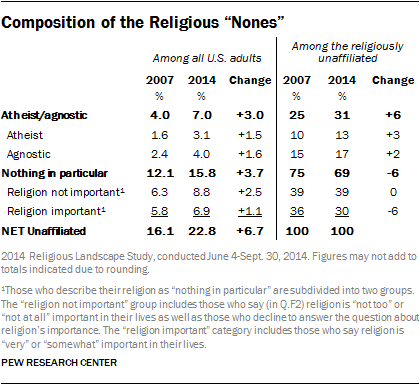 The religiously unaffiliated population – including all of its constituent subgroups – has grown rapidly as a share of the overall U.S. population. The share of self-identified atheists has most doubled in size since 2007, from i.half dozen% to three.one%. Agnostics take grown from 2.four% to 4.0%. And those who describe their religion as "nothing in item" have swelled from 12.1% to 15.8% of the adult population since 2007. Overall, the religious "nones" have grown from sixteen.1% to 22.8% of the population in the by seven years.
Every bit the unaffiliated have grown, the internal limerick of the religious "nones" has inverse. Near unaffiliated people continue to describe themselves as having no particular faith (rather than as being atheists or agnostics), but the "nones" appear to be growing more than secular. Atheists and agnostics at present account for 31% of all religious "nones," up from 25% in 2007.
Meanwhile, the share of the "nones" describing their religion every bit "cypher in detail" has declined from 75% in 2007 to 69% in 2014. And this decline is especially notable among those who say religion is "very" or "somewhat" important in their lives despite eschewing any identification with a item religion. Those who describe their religion as "goose egg in particular" and who also say that religion is important in their lives now account for 30% of all religious "nones," down from 36% in 2007. Those who describe their faith as "cipher in item" and furthermore state that religion is unimportant in their lives account for 39% of all religious "nones," the aforementioned share equally 2007.
A Note on How the Study Defines Evangelicals
How many Americans are evangelical Christians? The answer depends on how evangelicalism is existence divers.
 There are a number of ways this can be done. The approach taken in the 2014 Religious Landscape Report, for instance, focuses merely on Protestants. It looks at the denominations and congregations with which Protestants identify, and determines whether these denominations and congregations are part of the evangelical Protestant tradition, mainline Protestant tradition or historically black Protestant tradition. Those who belong to denominations and churches that are part of the evangelical Protestant tradition (such as the Southern Baptist Convention, the Assemblies of God and many nondenominational churches) are categorized as evangelical Protestants in the study; those who belong to denominations or churches in the other 2 Protestant traditions are non. Using this arroyo, the study finds that 25.4% of U.Southward. adults are evangelical Protestants, down from 26.3% in 2007, when the first Religious Landscape Study was conducted.
Another way to identify evangelicals is to enquire people whether they consider themselves evangelical or born-again Christians. The Religious Landscape Report includes a question asking Christians: "Would you draw yourself as a built-in-again or evangelical Christian, or not?" In response to this question, half of Christians (35% of all U.Southward. adults) say yeah, they do consider themselves born-once again or evangelical Christians. The share of self-described born-once again or evangelical Christians is very like to what it was in 2007, even though the overall Christian share of the population has declined.
 Not surprisingly, well-nigh members of the evangelical Protestant tradition (83%) see themselves every bit built-in-over again or evangelical Christians, equally do near members of the historically black Protestant tradition (72%) and a sizable minority of people in the mainline Protestant tradition (27%). Many Christians who exercise not identify with Protestantism also consider themselves born-once again or evangelical Christians, including 22% of Catholics, 18% of Orthodox Christians, 23% of Mormons and 24% of Jehovah'due south Witnesses.
 When Catholics, Mormons and other non-Protestants are excluded, the study finds that 3-in-ten U.Due south. adults are self-described built-in-once more or evangelical Protestants. Although the percent of Americans who place equally Protestants has declined in recent years (from 51% in 2007 to 47% today), the share of born-once again or evangelical Protestants has remained the same.
White born-again or evangelical Protestants – a group closely watched by political observers – now business relationship for xix% of the adult population, downward slightly from 21% in 2007. Over that period of time, the white share of respondents fell from 71% in the 2007 Religious Landscape Study to 66% in 2014.
Another way to define evangelical Protestants is to place a set of religious beliefs or practices that are central to evangelicalism, and so assess how many people profess those beliefs or engage in those practices. When measured this style, the size of the evangelical population depends on the particular beliefs and practices that are used to define the category. While this type of analysis is beyond the scope of the Religious Landscape Written report, a forthcoming study will examine the beliefs and practices of major religious groups and their views on social and political issues.
hernandezburses83.blogspot.com
Source: https://www.pewresearch.org/religion/2015/05/12/chapter-1-the-changing-religious-composition-of-the-u-s/
0 Response to "Born Again Christian Are Protestant Chrisitans"
Post a Comment